


How Michael Schumacher gave a newly unified Germany a way to feel proud of itself, and turned Formula 1 into something larger than sport.
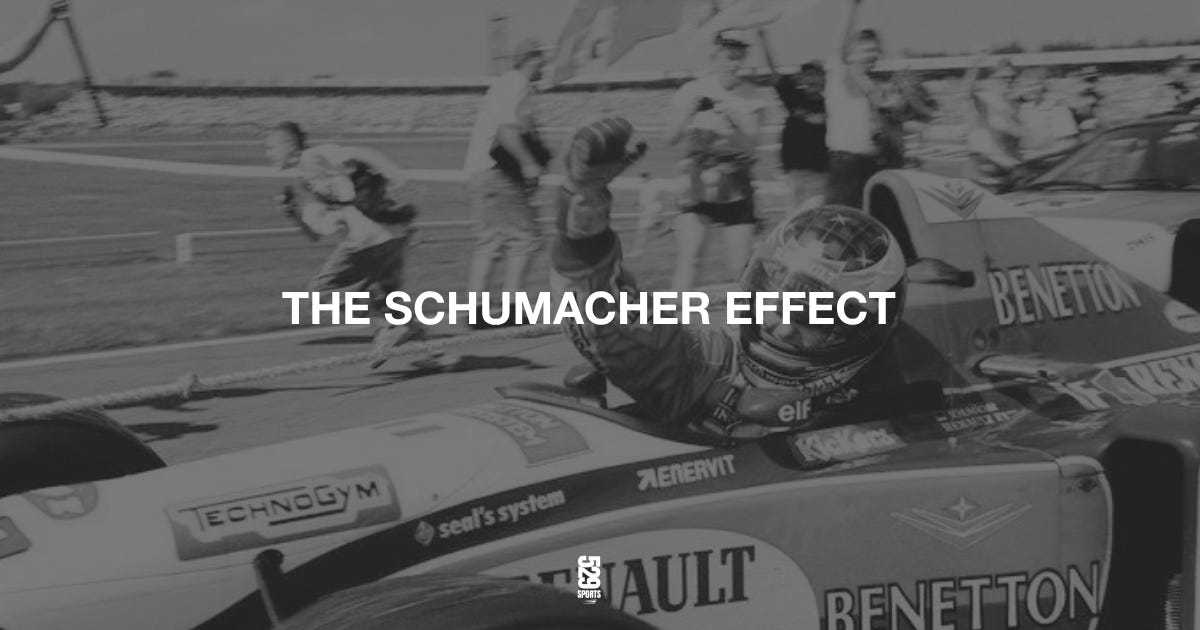
There was a time when Ferrari red felt strangely German. At the height of Michael Schumacher’s reign, the color appeared everywhere: on flags, caps, shirts, banners, the grandstands at Hockenheim. Germany had a driver who seemed almost impossibly precise, almost impossibly fast, winning in the most recognizable red in motorsport. The symbolism was peculiar but effective. Ferrari red was not the German flag, but it was the exact red at its center. Put a German tricolor beside a Ferrari flag and the colors seemed to bleed into one another.
In a video about Germany and the power of sport, former Formula 1 presenter Will Buxton tells the story of a German family at Hockenheim, describing a country still learning how to live with its own national identity after reunification. For generations, overt displays of German pride had carried a weight that national symbols did not necessarily carry elsewhere. Then came Schumacher. Suddenly, Buxton argues, people had a way to cheer for their country without having to say they were cheering for Germany. They could cheer for Michael.
Buxton’s point goes further. Schumacher became a kind of acceptable vessel for German pride, a public figure through whom people could express something that had long been difficult to express directly.
The question at the center of Schumacher’s story is therefore larger than how many races he won. Can one athlete change the way a country sees itself?
Schumacher arrived at exactly the right historical moment. Germany had reunified in 1990, but the cultural confidence that came with reunification did not arrive all at once. Public displays of nationalism remained complicated. In sport, where Italians could wave the tricolore and Brazilians could wear their colors without much explanation, German pride carried a different historical memory.
Schumacher offered an escape hatch.
He came from Kerpen, a small town near Cologne, and his image was almost comically unspectacular compared with the mythology that eventually surrounded him. He was methodical, serious, technical. He did not need to perform charisma when the stopwatch was doing the talking. His success felt distinctly German: engineered, disciplined, relentless.
Then came Hockenheim.
On the 30th of July 1995, Schumacher became the first German driver to win the German Grand Prix in the modern era. Around 120,000 people celebrated at the circuit. German flags filled the grandstands. Fireworks went off. Schumacher’s own account of the afternoon was almost overwhelmed by the noise: he said that in the final laps he could hear the fans celebrating more than he could hear his car.
This was the moment that helped turn Schumacher fandom into what Germany would come to call Schumi-Mania. His victory produced what contemporary German coverage described as a wave of enthusiasm, and his success helped transform Hockenheim into a kind of motorsport pilgrimage site.
He had not merely won a home race. He had given the country a sporting figure around whom national pride could gather.
Buxton’s argument is compelling precisely because Schumacher did not have to declare himself a national symbol. He did not need to wave a German flag from the cockpit and announce what he represented. The public did it for him.
And then he went to Ferrari.
The partnership made the symbolism even stranger. Ferrari had its own mythology, its own national identity and its own religion of red. Yet Schumacher’s victories made that red feel increasingly German. Fans could wave Ferrari flags, German flags, or both at once. To this day, photographs from the Schumacher era show amalgamations of the three: Michael’s face, the German tricolor and the Ferrari shield, layered together until driver, country and team become almost impossible to separate.
Schumacher had, as Buxton’s argument suggests, made it possible to experience German pride through something that did not carry the same historical burden. The country did not have to look backward to find a symbol of itself. It could look at a race car.
The phenomenon did not stay inside the circuit.
There was a measurable economic side to Schumacher’s popularity, too. In 2003, Hockenheim officials said a German Grand Prix weekend generated around €40 million in turnover and attracted roughly 300,000 spectators across the event. Hotels and campsites in the surrounding area were reporting strong advance bookings, while the city said roughly 3,000 businesses and 17,000 jobs benefited directly or indirectly from the Grand Prix. Officials identified Schumacher as the event’s principal draw.
It is difficult to attribute every euro of that activity to Schumacher himself, but the relationship was hardly theoretical. Hockenheim officials were explicitly discussing the prosperity surrounding the Grand Prix during the Schumacher era. The race brought spectators into the region, filled accommodation and generated business well beyond the circuit gates. Schumacher had helped turn a Formula 1 weekend into a regional economic event.
I have seen the Schumacher effect in miniature myself.
A friend from Spremberg once told me that, when she was growing up, whenever someone drove a little too quickly past her family’s house, her grandfather would scoff, “He thinks he’s Schumacher.”
It is the sort of sentence that survives because the person being referenced has ceased to be merely a person. His name has become shorthand.
That may be Schumacher’s most enduring achievement.
Not the seven championships. Not even the records.
It is that “Schumacher” became a cultural language in Germany.
After his career, other German drivers achieved extraordinary things. Sebastian Vettel won four championships. Nico Rosberg became world champion. Yet the particular national phenomenon of the Schumacher years proved difficult to reproduce. Hockenheim attendance later fluctuated, and German interest in Formula 1 changed as the Schumacher generation disappeared. In 2018, the circuit’s management recalled that more than 100,000 spectators had once attended during Schumacher’s era.
Perhaps that is because Schumacher’s story was never only about winning.
After his 2013 skiing accident, the public lost access to the man behind the mythology. His family has fiercely protected his privacy, leaving an enormous space in which memory, speculation and nostalgia have accumulated. The Schumacher name became less like that of a retired athlete and more like a piece of German cultural memory.
Now that memory is being revisited. Schumacher ’94: The Birth of a Legend, a new Netflix documentary, is out now, returning to the season in which Schumacher won his first world championship through personal interviews and archival footage.
It arrives at an interesting moment because the story is no longer simply about how many races Schumacher won. It is about what those victories meant to the people watching them.
Michael Schumacher never needed to announce himself as a national hero. He did not have to tell Germany how to feel about itself. He simply drove.
But somewhere between Kerpen and Hockenheim, between Benetton and Ferrari, between the German flag and the Ferrari flag, a country found a new way to cheer for itself.
The colors made the symbolism almost too perfect: black, red and gold beside Ferrari’s unmistakable red, Michael’s name printed across both. For years, the images repeated themselves. Schumacher on the podium. A German flag behind him. Ferrari red everywhere else. A driver, a team and a country becoming, for a moment, part of the same picture.
At the top step of a Formula 1 podium, beneath a cloud of champagne and surrounded by the unmistakable red of Ferrari, stood a German who had somehow made national pride feel uncomplicated again.
That may be the most enduring part of the Schumacher effect.